How to Control the Mind According to Hindu Philosophy
Oct 19, 2026 · 11 min read · 30 views
Introduction
The human mind is one of the most powerful aspects of our existence. It can guide us toward peace, happiness, wisdom, and spiritual growth. However, an uncontrolled mind can also become a source of stress, fear, anger, jealousy, and unnecessary worries.
According to Hindu philosophy, controlling the mind is an essential step toward self-realization and inner peace. Ancient Hindu scriptures, including the Bhagavad Gita, the Upanishads, and the Yoga Sutras of Patanjali, offer valuable teachings on understanding the mind and developing self-discipline.
But what does it really mean to control the mind? Does it mean stopping every thought? No. It means learning to understand our thoughts, manage our emotions, and direct our attention toward what is meaningful and beneficial.
Let us explore how Hindu philosophy teaches us to control the mind and live a peaceful, balanced, and spiritual life.
1. Understand the Nature of the Mind
Hindu philosophy explains that the mind is constantly moving from one thought to another. Sometimes we think about the past, while at other times we worry about the future. This continuous movement can disturb our inner peace.
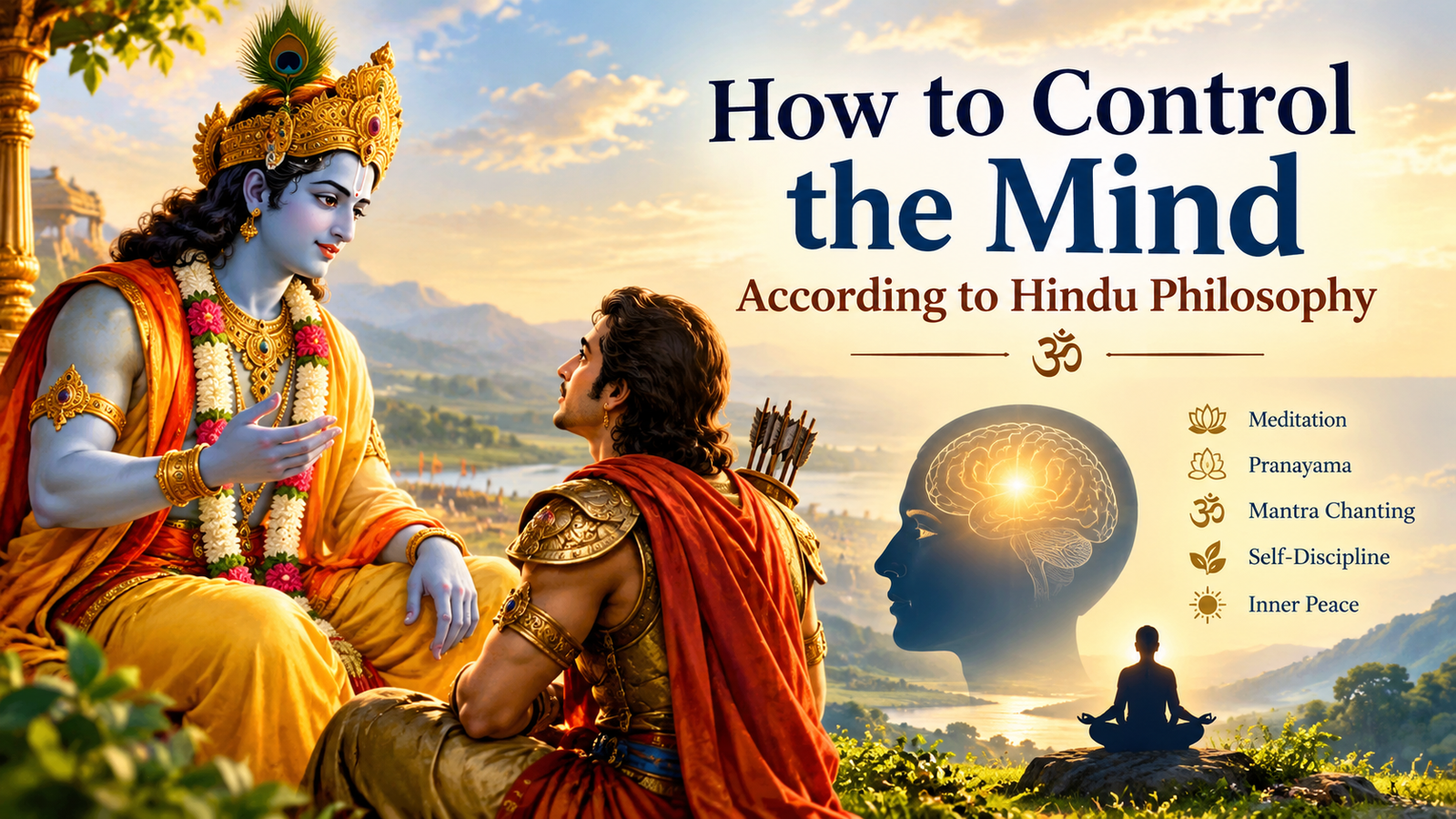
In the Bhagavad Gita, Arjuna tells Lord Krishna that controlling the mind is extremely difficult because it is restless and powerful.
Lord Krishna acknowledges this difficulty but explains that the mind can be controlled through practice and detachment.
This teaching reminds us that an uncontrolled mind is not a personal failure. Developing mental discipline requires patience, effort, and regular practice.
Practical lesson: Instead of fighting every thought, observe your thoughts without immediately reacting to them.
2. Practice Abhyasa and Vairagya
One of the most important teachings of the Bhagavad Gita is that the mind can be trained through two practices: Abhyasa and Vairagya.
Abhyasa – Consistent Practice
Abhyasa means repeated and dedicated practice. Just as the body becomes stronger through regular exercise, the mind develops discipline through consistent training.
You can practice Abhyasa by:
- Meditating for a few minutes every day.
- Repeating a mantra with attention.
- Reading spiritual scriptures regularly.
- Bringing your attention back whenever it wanders.
- Developing positive daily habits.
Vairagya – Detachment
Vairagya means reducing excessive attachment to desires, possessions, expectations, and outcomes.
Detachment does not mean abandoning your responsibilities or relationships. It means performing your duties without allowing your happiness to depend entirely on external circumstances.
Practical lesson: Do your best, accept what you cannot control, and learn from every experience.
3. Learn from the Bhagavad Gita
The Bhagavad Gita provides profound guidance on mastering the mind.
In Chapter 6, Verse 5, Lord Krishna teaches that a person should uplift oneself through one's own mind rather than allow the mind to become an obstacle.
The central idea is that our thoughts and habits can either support our growth or hold us back.
When we repeatedly think negatively, we may lose confidence and motivation. When we cultivate awareness, wisdom, and positive actions, we create better conditions for inner peace.
The Bhagavad Gita also teaches us to perform our duties sincerely without becoming excessively attached to the results.
Practical lesson: Focus on your actions rather than constantly worrying about success, failure, praise, or criticism.
4. Practice Meditation (Dhyana)
Meditation, known as Dhyana in Hindu spiritual traditions, is an important practice for developing concentration and self-awareness.
The purpose of meditation is not necessarily to eliminate every thought. Instead, it helps us observe the mind without becoming controlled by every thought that arises.
How to Meditate
1. Find a quiet and comfortable place.
2. Sit in a relaxed, upright position.
3. Close your eyes gently, if comfortable.
4. Pay attention to your natural breathing.
5. When thoughts arise, notice them without judgment.
6. Gently return your attention to your breath.
7. Begin with five minutes daily and increase gradually if you wish.
With regular practice, meditation can help develop attention and emotional awareness. Results differ from person to person, so be patient with yourself.
5. Control the Mind Through Pranayama
Pranayama refers to yogic practices involving the regulation of breathing. In Hindu and yogic traditions, the breath is closely associated with the condition of the mind.
When we feel anxious or angry, our breathing may become quick and shallow. Slow, comfortable breathing can help us settle down and respond more thoughtfully.
Simple Breathing Practice
- Sit comfortably in a quiet place.
- Breathe gently through your nose.
- Allow the breath to remain natural and relaxed.
- Observe each inhalation and exhalation.
- Continue for two to five minutes without forcing your breath.
Avoid straining or holding your breath for long periods, especially if you are a beginner.
Practical lesson: When your mind feels disturbed, pause and take a few gentle breaths before responding.
6. Practice Self-Control Through the Senses
According to Hindu philosophy, our senses constantly draw our attention toward the outside world. Excessive stimulation and uncontrolled desires can make the mind restless.
The Bhagavad Gita teaches the importance of regulating the senses rather than becoming their servant.
This does not mean avoiding every pleasure. It means learning to make conscious choices instead of acting on every impulse.
You can develop this discipline by:
- Limiting unnecessary social media use.
- Avoiding excessive entertainment.
- Eating mindfully.
- Speaking thoughtfully.
- Taking breaks from digital distractions.
- Choosing habits that support your well-being.
Practical lesson: Before following an impulse, pause and ask yourself whether the action will genuinely benefit you.
7. Use Mantra Chanting to Calm the Mind
Mantra chanting is a traditional spiritual practice in Hinduism. Repeating a sacred mantra with attention can provide a steady focus for the mind.
Some commonly used mantras include:
- Om: A sacred sound associated with spiritual contemplation.
- Om Namah Shivaya: A mantra devoted to Lord Shiva.
- Om Namo Bhagavate Vasudevaya: A devotional mantra associated with Lord Vishnu.
- Gayatri Mantra: A sacred Vedic mantra seeking illumination and wisdom.
Choose a mantra that suits your spiritual tradition and beliefs. Sit quietly and repeat it slowly, giving your attention to the sound and meaning.
When the mind wanders, gently return to the mantra.
Mantra chanting is not about forcing the mind into silence. It is about giving the mind a meaningful point of focus.
8. Develop Sattva Guna
According to Samkhya and related Hindu philosophical traditions, nature is described through three gunas: Sattva, Rajas, and Tamas.
Sattva – Clarity and Harmony
Sattva is associated with clarity, knowledge, balance, and peace.
Rajas – Activity and Restlessness
Rajas is associated with activity, ambition, desire, and agitation.
Tamas – Inertia and Dullness
Tamas is associated with heaviness, inactivity, and confusion.
These qualities are not simply labels for good or bad people. They describe tendencies that can influence our thoughts and behavior.
To encourage greater clarity and balance, you can:
- Maintain a regular sleep schedule.
- Eat balanced and nourishing meals.
- Spend time in nature.
- Read uplifting and meaningful literature.
- Practice kindness and honesty.
- Keep your surroundings reasonably organized.
- Avoid habits that leave you feeling constantly distracted or exhausted.
Practical lesson: A balanced lifestyle can support a clearer and more disciplined mind.
9. Practice Karma Yoga
Karma Yoga is the path of selfless action. The Bhagavad Gita teaches that we should perform our duties sincerely without becoming overly attached to their fruits.
When our minds are constantly occupied with recognition, comparison, rewards, or fear of failure, we may lose peace.
Karma Yoga encourages us to concentrate on the quality of our actions rather than allowing the results to determine our entire sense of worth.
You can practice Karma Yoga by:
- Doing your work honestly.
- Helping others without always expecting something in return.
- Accepting mistakes as opportunities to learn.
- Performing daily responsibilities with awareness.
- Treating success and failure as experiences from which to grow.
Practical lesson: Give your best effort and allow wisdom, rather than anxiety, to guide your actions.
10. Observe Your Thoughts Without Identifying With Them
A powerful idea in Hindu philosophy is the distinction between the changing contents of the mind and the deeper Self, often discussed through the concepts of Atman and awareness.
Thoughts come and go. Emotions rise and fall. Yet through observation, we can begin to recognize that every thought does not have to define who we are.
For example, instead of saying, “I am a failure,” you might recognize, “I am having a thought that I have failed.”
This small change creates space between a thought and your response.
Self-observation can help you respond with greater clarity instead of acting immediately out of fear, anger, or sadness.
Practical lesson: Notice your thoughts, understand them, and choose your response consciously.
11. Practice Forgiveness and Gratitude
Anger, resentment, jealousy, and constant comparison can disturb the mind. Hindu ethical teachings encourage qualities such as compassion, forgiveness, truthfulness, and contentment.
Forgiveness does not mean approving of harmful behavior or abandoning healthy boundaries. It means gradually releasing unnecessary bitterness when possible.
Gratitude helps us recognize the value of what we already have rather than focusing exclusively on what is missing.
Try these simple practices:
- Remember three things you appreciate each day.
- Avoid comparing your life constantly with others.
- Speak kindly to yourself and other people.
- Apologize when you make a mistake.
- Set healthy boundaries when necessary.
- Spend a few moments reflecting on your actions before sleeping.
Over time, these habits can encourage a more thoughtful and balanced approach to life.
12. Follow a Simple Daily Routine for Mental Peace
You do not need to change your entire life in one day. Start with a few simple practices and follow them consistently.
Morning
- Wake up at a regular time.
- Spend five minutes in meditation or prayer.
- Practice gentle breathing.
- Read a meaningful passage from the Bhagavad Gita.
During the Day
- Focus on one task at a time.
- Pause before reacting in anger.
- Perform your duties sincerely.
- Take short breaks from digital distractions.
- Treat others with patience and respect.
Evening
- Spend a few minutes in quiet reflection.
- Notice which thoughts disturbed your peace.
- Consider what you learned during the day.
- Practice gratitude.
- Prepare for restful sleep.
Remember that consistency is more important than perfection. Even a few minutes of daily practice can be a useful beginning.
Conclusion
According to Hindu philosophy, controlling the mind is a journey of self-understanding, discipline, and spiritual growth. The Bhagavad Gita teaches the importance of regular practice and detachment, while meditation, pranayama, mantra chanting, selfless action, and ethical living offer practical ways to cultivate greater awareness.
The goal is not to suppress every thought or avoid every difficulty. It is to develop the wisdom to recognize your thoughts, regulate your reactions, and choose your actions consciously.
When you learn to guide your mind instead of following every impulse, you create space for greater peace, clarity, and balance.
Remember: A disciplined mind can become a powerful friend on the path to inner peace and self-realization.
Begin with one small practice today, remain patient with yourself, and continue moving forward with awareness and faith.
Frequently Asked Questions (FAQs)
1. How can I control my mind according to Hindu philosophy?
Hindu philosophy recommends regular practice, detachment, meditation, self-discipline, and awareness. The Bhagavad Gita particularly emphasizes Abhyasa (practice) and Vairagya (detachment).
2. What does Lord Krishna say about controlling the mind?
In the Bhagavad Gita, Chapter 6, Verse 35, Lord Krishna explains that the restless mind can be restrained through practice and detachment.
3. Which mantra is best for calming the mind?
Om, Om Namah Shivaya, and other traditional mantras may serve as helpful focal points for meditation. Choose one that aligns with your beliefs and practice it with attention.
4. How long should I meditate every day?
Beginners can start with five minutes daily and gradually increase the duration according to their comfort and needs.
5. Can meditation help reduce negative thoughts?
Meditation can help people become more aware of their thoughts and respond to them more deliberately. It does not guarantee that negative thoughts will disappear completely.
6. What is the difference between mind control and mind suppression?
Mind control means developing awareness and choosing how to respond to thoughts and emotions. Mind suppression means trying to force thoughts away. Hindu spiritual practices generally emphasize discipline, understanding, and detachment rather than simply fighting every thought.
7. What is the most important teaching of the Bhagavad Gita about the mind?
One central teaching is that the mind can become either a friend or an obstacle, depending on how it is trained and directed. Regular practice and detachment are important for developing mastery over it.
Final Thoughts
The journey toward mental peace begins within. Through the wisdom of Hindu philosophy, we can learn to live with greater awareness, perform our duties sincerely, and cultivate a calmer relationship with our thoughts.
Control your mind through awareness, strengthen it through practice, and guide your life with wisdom.