The Meaning of Moksha in Hinduism: A Complete Guide to Spiritual Liberation
Oct 15, 2026 · 10 min read · 92 views
The Meaning of Moksha in Hinduism: A Complete Guide to Spiritual Liberation
Moksha in Hinduism is one of the most important concepts in Sanatan Dharma. It represents spiritual liberation, freedom from the cycle of birth and death, and the realization of one's true nature. Hindu philosophy teaches that human life is not only about material success, wealth, and happiness but also about discovering the deeper truth of existence.
Moksha is considered the ultimate spiritual goal in many Hindu traditions. It encourages individuals to overcome ignorance, attachment, ego, and worldly desires and move toward self-realization and spiritual freedom.
In this article, we will explore the meaning of Moksha, its importance in Hinduism, the four paths to liberation, and how its teachings can guide us in everyday life.
What Is Moksha in Hinduism?
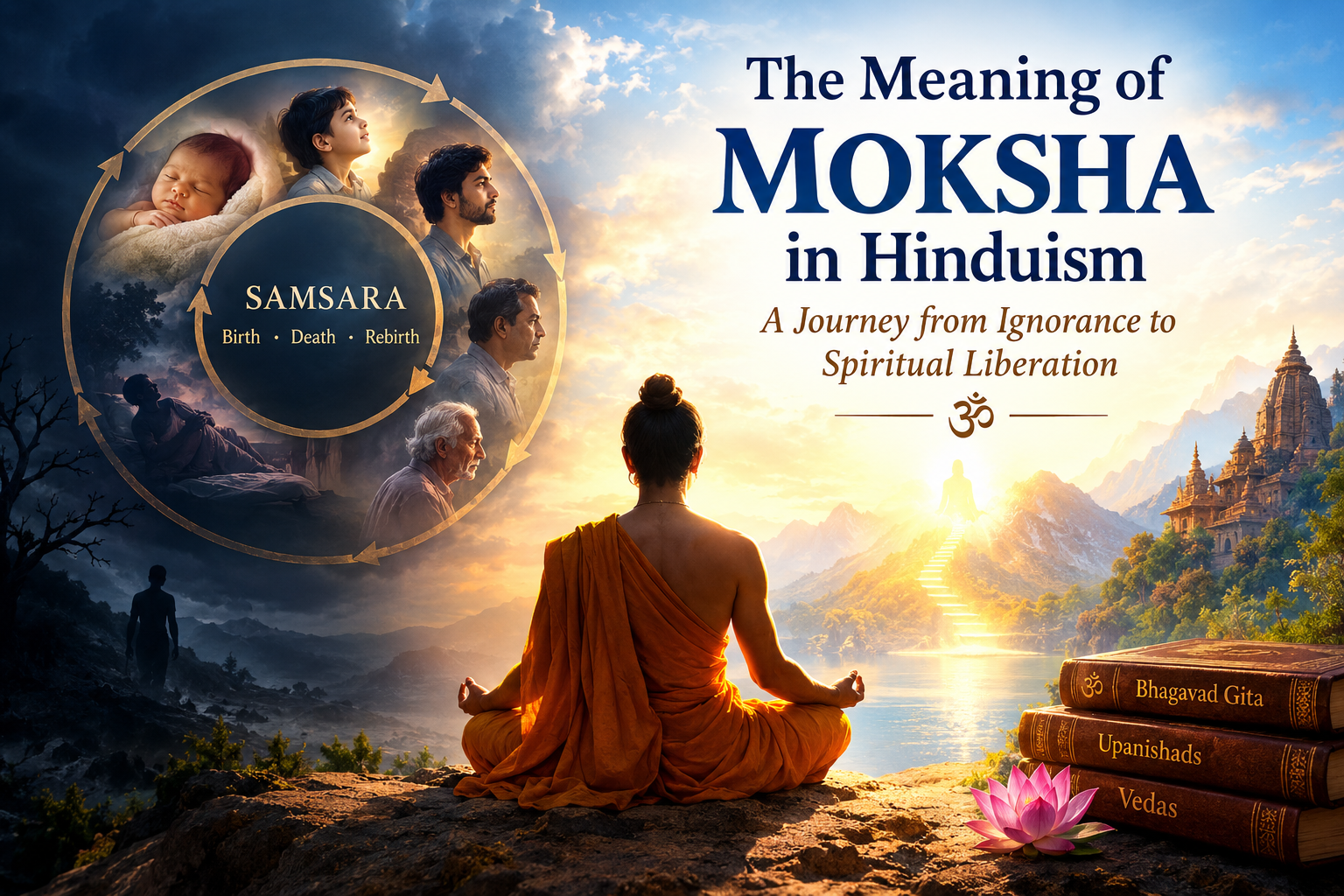
The word Moksha comes from the Sanskrit root muc, which means to release or free. In Hinduism, Moksha refers to liberation from Samsara, the continuous cycle of birth, death, and rebirth.
According to many Hindu philosophical traditions, the true self, known as the Atman, is deeper than the physical body and the changing mind. Spiritual ignorance causes people to identify themselves only with their bodies, possessions, emotions, and worldly identities.
Moksha is the freedom that comes through realizing spiritual truth and overcoming this ignorance.
Different Hindu traditions explain Moksha in different ways. Advaita Vedanta emphasizes the realization of the essential unity of Atman and Brahman, while other traditions emphasize eternal closeness to, service to, or the grace of God.
Importance of Moksha in Sanatan Dharma
Moksha holds a special place in Hindu spiritual philosophy because it is regarded as the highest of the four Purusharthas, or aims of human life.
The four Purusharthas are:
1. Dharma: Living according to righteousness, duty, and moral principles.
2. Artha: Acquiring wealth and resources through appropriate means.
3. Kama: Experiencing legitimate desires, love, pleasure, and happiness.
4. Moksha: Attaining spiritual liberation and freedom from Samsara.
These four aims provide a framework for a balanced life. Hindu teachings do not necessarily require everyone to abandon family or society to seek Moksha. Many traditions encourage people to fulfill their responsibilities while cultivating wisdom, devotion, and detachment.
Moksha reminds us that material achievements are temporary and that spiritual understanding can bring a deeper sense of freedom and fulfillment.
What Is the Cycle of Birth and Death?
The cycle of birth, death, and rebirth is known as Samsara in Hinduism.
According to Hindu beliefs, actions performed with intention have consequences. This principle is known as Karma. Karma influences future experiences and, in traditional Hindu teachings, may also influence future births.
As long as ignorance and attachment continue, the individual remains bound to Samsara. Moksha represents liberation from this cycle.
The Bhagavad Gita explains that the soul is not destroyed when the physical body dies. In Chapter 2, Lord Krishna teaches Arjuna about the eternal nature of the self and the importance of understanding the difference between the body and the soul.
This teaching encourages people to look beyond temporary circumstances and seek lasting spiritual wisdom.
Four Paths to Attaining Moksha
Hindu philosophy describes several spiritual paths that can help a person progress toward liberation. Four commonly discussed paths are Karma Yoga, Bhakti Yoga, Jnana Yoga, and Raja Yoga.
1. Karma Yoga – The Path of Selfless Action
Karma Yoga teaches that people should perform their duties sincerely without becoming excessively attached to the results.
In the Bhagavad Gita, Lord Krishna explains the importance of performing one's prescribed duties without allowing the desire for rewards to control one's actions.
Karma Yoga can be practiced by helping others, fulfilling family responsibilities, working honestly, and serving society without selfish motives.
Example: Helping someone in need without expecting praise or a personal reward is an example of selfless action.
2. Bhakti Yoga – The Path of Devotion
Bhakti Yoga is the path of love, faith, surrender, and devotion to God.
Devotees may express their devotion through prayer, chanting mantras, singing bhajans, reading sacred scriptures, visiting temples, and remembering God in daily life.
Different Hindu traditions direct devotion toward different forms of the Divine, including Lord Vishnu, Lord Shiva, Goddess Durga, Lord Krishna, and Lord Rama.
Bhakti teaches humility, compassion, gratitude, and trust in divine grace. In many devotional traditions, God's grace plays a central role in attaining Moksha.
3. Jnana Yoga – The Path of Knowledge
Jnana Yoga is the path of spiritual knowledge, self-inquiry, and discernment.
It encourages individuals to question their assumptions and understand the difference between the temporary physical world and the deeper nature of the self.
Through the study of the Upanishads, reflection on sacred teachings, and guidance from a qualified teacher, seekers work toward overcoming ignorance.
Questions such as “Who am I beyond my body and thoughts?” and “What is the true nature of existence?” are central to this path.
Jnana Yoga is particularly important in Vedantic traditions, although its interpretation varies among Hindu schools.
4. Raja Yoga – The Path of Meditation
Raja Yoga emphasizes discipline of the mind, meditation, concentration, and inner awareness.
Through regular spiritual practice, a person learns to observe thoughts and emotions without being completely controlled by them.
Meditation, ethical conduct, breath awareness, and self-discipline can support this journey.
The Yoga Sutras of Patanjali provide an influential framework for understanding the practice of yoga and the quieting of mental fluctuations.
Raja Yoga helps seekers cultivate inner stillness and deeper self-understanding.
What Is the Difference Between Moksha and Nirvana?
Moksha and Nirvana are both associated with spiritual freedom, but they come from different religious and philosophical traditions.
Moksha is a central concept in Hinduism and is generally associated with liberation from Samsara and the realization of spiritual truth.
Nirvana is a central concept in Buddhism, where it refers to the ending of craving, ignorance, and suffering. Buddhist teachings do not accept the permanent, unchanging self in the same way that many Hindu traditions understand Atman.
Although the terms share certain similarities, they should not be treated as exactly identical because their philosophical meanings differ.
Can Moksha Be Attained During One's Lifetime?
Many Hindu traditions recognize the possibility of attaining liberation while still alive. This state is often called Jivanmukti, meaning liberation while living.
A Jivanmukta is traditionally understood as someone who has realized spiritual truth and is no longer bound by ignorance in the ordinary way.
Such a person may continue performing daily activities, fulfilling responsibilities, and interacting with the world while remaining inwardly free from attachment.
However, Hindu schools differ in how they explain the relationship between liberation, the body, karma, and life after death.
The idea of Jivanmukti teaches that spiritual freedom is not necessarily dependent on escaping society or waiting until the end of life.
How Can We Apply the Teachings of Moksha in Daily Life?
Although Moksha is an ultimate spiritual goal, its teachings can inspire practical changes in everyday life.
Here are some ways to apply these principles:
- Practice self-awareness: Observe your thoughts, emotions, and reactions.
- Reduce attachment: Appreciate what you have without believing that possessions define your identity.
- Perform your duties: Work honestly and fulfill your responsibilities with sincerity.
- Practice meditation: Spend a few minutes each day in silence and reflection.
- Cultivate devotion: Pray, chant mantras, or remember God according to your spiritual tradition.
- Develop compassion: Treat others with kindness and respect.
- Study sacred texts: Read the Bhagavad Gita, the Upanishads, and other scriptures with reflection.
- Control the ego: Be willing to learn, accept mistakes, and respect different perspectives.
These practices do not automatically guarantee Moksha, but they can help cultivate the qualities that Hindu spiritual traditions associate with the path to liberation.
Teachings of the Bhagavad Gita About Moksha
The Bhagavad Gita offers profound teachings about spiritual knowledge, disciplined action, devotion, and liberation.
Lord Krishna guides Arjuna toward understanding the eternal nature of the self, performing duty without attachment, and developing devotion to the Divine.
The Gita presents different spiritual approaches rather than limiting every seeker to one single method. It emphasizes that sincere spiritual practice, right understanding, and devotion can transform the way a person lives.
Its message is especially meaningful because it is delivered in the context of Arjuna's responsibilities. Rather than simply telling him to abandon the world, Krishna teaches him how to act with wisdom and spiritual awareness.
Is Moksha the Same as Going to Heaven?
No. Moksha and heaven are not necessarily the same in Hinduism.
Heaven, commonly called Svarga, is generally described in Hindu traditions as a desirable realm associated with the results of meritorious actions. However, it is usually considered part of Samsara rather than permanent liberation.
Moksha, by contrast, means freedom from the cycle of birth and death.
Different Hindu schools explain the nature of liberation in different ways, but Moksha is generally regarded as more fundamental than temporary enjoyment in a heavenly realm.
Conclusion
Moksha is one of the deepest and most meaningful concepts in Hinduism. It represents spiritual liberation, freedom from Samsara, and the realization of truth beyond ignorance and attachment.
The paths of Karma Yoga, Bhakti Yoga, Jnana Yoga, and Raja Yoga offer different approaches to spiritual growth. Through selfless action, devotion, knowledge, and meditation, seekers can work toward greater wisdom and inner freedom.
The teachings of Moksha remind us that the purpose of life can extend beyond material achievements. By living with compassion, fulfilling our duties, cultivating self-awareness, and seeking spiritual knowledge, we can bring the values of Sanatan Dharma into our everyday lives.
Moksha is not merely an idea about life after death; it is a profound spiritual ideal that invites us to discover the deeper truth of existence.
Frequently Asked Questions (FAQs)
1. What is the simple meaning of Moksha?
Moksha means spiritual liberation. In Hinduism, it generally refers to freedom from the cycle of birth, death, and rebirth.
2. What is the main goal of Moksha?
The main goal is liberation from Samsara and the overcoming of spiritual ignorance. Different Hindu traditions explain the final state of liberation in different ways.
3. What are the four paths to Moksha?
The four commonly discussed paths are Karma Yoga (selfless action), Bhakti Yoga (devotion), Jnana Yoga (knowledge), and Raja Yoga (meditation and mental discipline).
4. Can a person attain Moksha while alive?
Many Hindu traditions accept the concept of Jivanmukti, or liberation while living, although explanations differ among philosophical schools.
5. What is the difference between Moksha and heaven?
Heaven is generally understood as a temporary realm within the cycle of existence, whereas Moksha is liberation from Samsara.
6. Which Hindu scripture explains Moksha?
The Bhagavad Gita, Upanishads, and Brahma Sutras discuss spiritual knowledge and liberation. Their teachings are interpreted differently by various Hindu philosophical traditions.
7. Is Moksha the ultimate goal of Hinduism?
Moksha is traditionally regarded as the highest of the four Purusharthas, or aims of human life, in many Hindu traditions.
8. How can we begin the journey toward Moksha?
A seeker can begin with ethical living, selfless service, devotion, meditation, self-inquiry, and the study of Hindu scriptures.
#SanatanDharma #Spirituality #BhagavadGita #HinduPhilosophy #SpiritualLiberation #IndianSpirituality