
📖भगवद्गीता अध्याय: १३ — क्षेत्रक्षेत्रज्ञविभागयोग (Kshetra Kshetrajna Vibhaga Yoga)
Oct 6, 2026 · 7 min read · 98 views
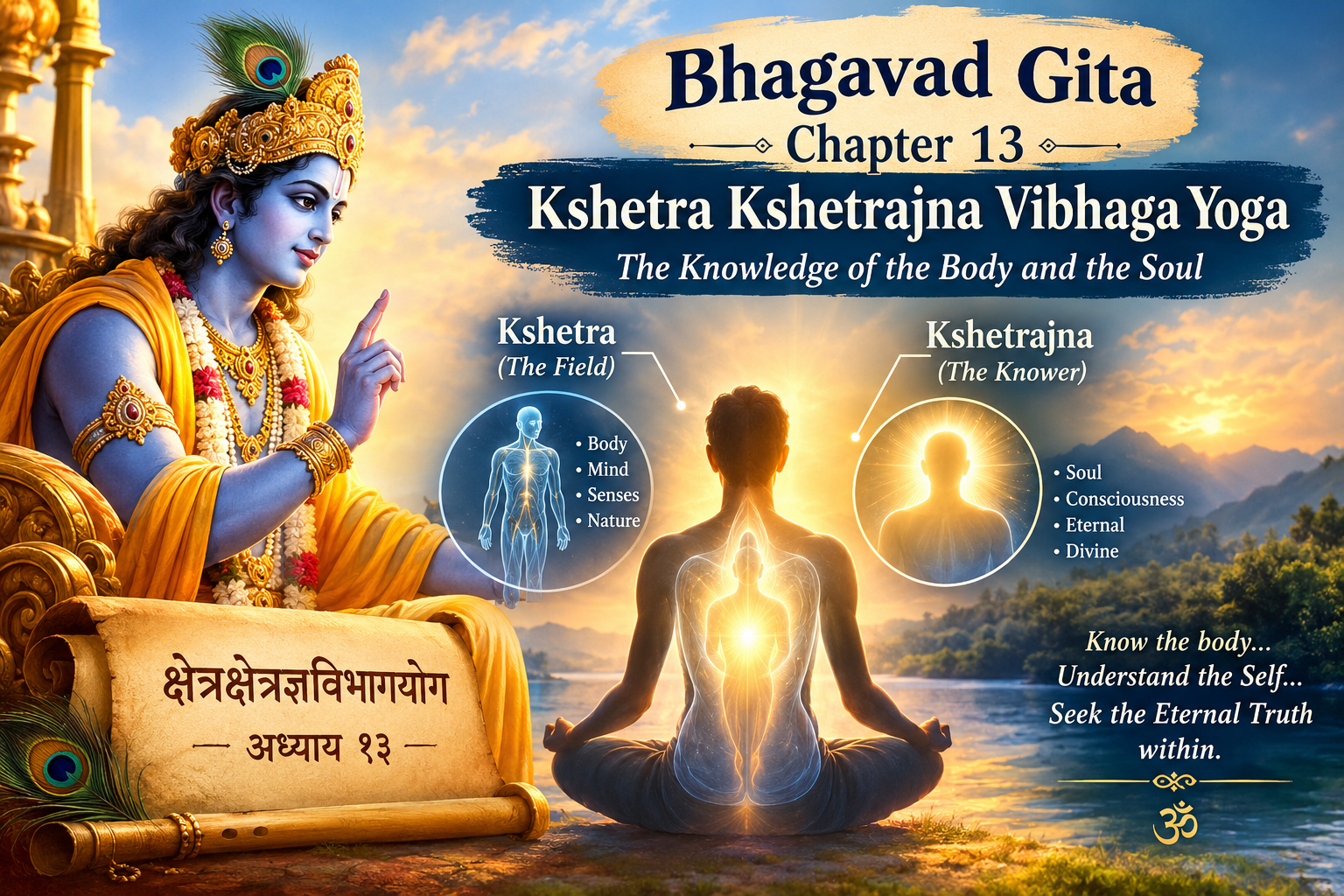
Bhagavad Gita Chapter 13, known as Kshetra Kshetrajna Vibhaga Yoga, is one of the most profound chapters of the Bhagavad Gita. The Sanskrit word Kshetra means “the field,” while Kshetrajna means “the knower of the field.”
In this chapter, Lord Krishna explains the difference between the body and the soul, between matter and consciousness, and between the temporary physical world and the eternal Self. The teachings help us understand who we truly are beyond the body, mind, emotions, and worldly identity.
What Is Kshetra?
According to Lord Krishna, the physical body is called Kshetra, or the field.
The body is made up of various physical and mental elements. It experiences pleasure and pain, happiness and sorrow, birth and death. Everything that happens to the body belongs to the temporary field of material existence.
Our body changes throughout life. Childhood becomes youth, youth becomes old age, and eventually the body comes to an end. However, the consciousness that experiences these changes is different from the changing body.
Understanding this difference is an important step toward spiritual knowledge.
Who Is Kshetrajna?
The Kshetrajna is the “knower of the field.” It refers to the conscious Self that knows and experiences the body.
The body can be observed, but the observer is different from the body. We can say, “My body,” “My mind,” or “My thoughts.” This raises an important question: Who is the “I” that observes all these things?
Lord Krishna teaches that the true Self is the conscious soul, which is beyond the temporary physical body.
The soul is not destroyed when the body changes or dies. It is eternal and spiritual.
The Difference Between Body and Soul
One of the central teachings of Chapter 13 is understanding the difference between the body and the soul.
The body is:
- Temporary
- Subject to birth and death
- Constantly changing
- Made of material elements
- Affected by pleasure and pain
The soul is:
- Eternal
- Conscious
- Spiritual
- Beyond physical change
- Not destroyed by the death of the body
When a person understands this distinction, attachment to temporary things gradually decreases.
What Is True Knowledge?
Lord Krishna explains that true knowledge is not simply collecting information or becoming intellectually clever. Real knowledge involves developing qualities that lead a person toward wisdom and self-realization.
These qualities include humility, non-violence, patience, purity, self-control, sincerity, and detachment from excessive material desires.
A truly knowledgeable person understands that worldly possessions, status, beauty, and physical strength are temporary.
Such a person begins to search for the eternal truth within.
Understanding Nature and the Self
Chapter 13 also explains the relationship between Prakriti and Purusha.
Prakriti, or material nature, is responsible for the physical and material aspects of existence. The body, senses, mind, and various material experiences belong to the field of Prakriti.
Purusha refers to the conscious principle, the experiencer or knower.
Human life becomes meaningful when we understand the difference between these two.
When we identify completely with the body and material possessions, we experience attachment, fear, anger, and sorrow. But when we recognize our spiritual nature, we begin to experience greater peace and inner clarity.
The Presence of the Supreme
Lord Krishna teaches that the Supreme Being is present within all living beings.
Although people appear different because of their bodies, minds, cultures, and circumstances, the Divine presence exists within every being.
This understanding encourages us to treat others with compassion, respect, and equality.
When we see the same Divine presence in all creatures, hatred and unnecessary discrimination gradually disappear.
Why Is Self-Knowledge Important?
Self-knowledge helps us understand our true identity.
In everyday life, we often identify ourselves with our name, profession, family role, possessions, appearance, or social position. But all these identities are temporary.
The Bhagavad Gita encourages us to look deeper and ask:
“Who am I beyond my body and worldly identity?”
This question is the beginning of spiritual inquiry.
When a person understands the eternal nature of the Self, fear of change and death becomes weaker. The person becomes more balanced during both happiness and difficulties.
The Body Is Temporary, but the Soul Is Eternal
The physical body is constantly changing. Every stage of life brings changes in our appearance, abilities, and experiences.
Yet there is a continuous sense of “I” throughout these changes.
The Bhagavad Gita teaches that the soul is eternal and does not perish with the body. Therefore, spiritual wisdom means learning to recognize the eternal Self rather than becoming completely attached to the temporary body.
This does not mean that we should neglect our body. Instead, we should take care of it while understanding that it is not our ultimate identity.
Lessons from Bhagavad Gita Chapter 13
Chapter 13 gives several important lessons for daily life:
1. Know Your True Self
We are more than our physical body and temporary identity.
2. Accept Change
Everything material changes. Learning to accept change helps us remain peaceful.
3. Practice Humility
True wisdom makes a person humble rather than arrogant.
4. Control the Mind and Senses
Self-control helps us make better decisions and avoid unnecessary suffering.
5. Develop Compassion
Seeing the Divine presence in all beings encourages kindness and respect.
6. Reduce Material Attachment
Possessions and status are temporary. Inner peace is more valuable than external success.
7. Seek Spiritual Knowledge
Understanding the Self and the Supreme Being is one of the highest purposes of human life.
Bhagavad Gita Chapter 13 in Daily Life
The teachings of Kshetra Kshetrajna Vibhaga Yoga are not limited to spiritual discussions. They can be applied to everyday life.
When someone insults us, we can remind ourselves that temporary opinions do not define our true Self.
When we experience success, we can remain humble because success is also temporary.
When we face difficulties, we can develop patience by remembering that circumstances constantly change.
When we experience fear about the future, spiritual understanding can give us inner strength.
Thus, the wisdom of Chapter 13 helps us develop a more balanced and peaceful approach to life.
Conclusion
Bhagavad Gita Chapter 13 – Kshetra Kshetrajna Vibhaga Yoga teaches us one of the deepest truths of spiritual life: the body is the field, while the soul is the knower of the field.
The body is temporary and constantly changing, but the soul is eternal. By understanding the difference between the physical body and the spiritual Self, we can gradually overcome ignorance, attachment, fear, and unnecessary suffering.
Lord Krishna's teachings remind us that true knowledge is not merely knowing about the world. It is knowing who we truly are.
The journey of self-knowledge begins when we look beyond the temporary body and recognize the eternal consciousness within.
“Know the body, understand the Self, and seek the eternal truth within.” 🙏
Frequently Asked Questions
1. What is Kshetra in Bhagavad Gita Chapter 13?
Kshetra means “the field” and primarily refers to the physical body along with its material and mental aspects.
2. What is Kshetrajna?
Kshetrajna means “the knower of the field.” It refers to the conscious Self or soul that experiences the body.
3. What is the main teaching of Chapter 13?
The main teaching is to understand the difference between the temporary body and the eternal Self and to develop spiritual knowledge.
4. Is the soul different from the body?
Yes. According to the Bhagavad Gita, the body is temporary and changing, while the soul is eternal and spiritual.
5. What can we learn from Kshetra Kshetrajna Vibhaga Yoga?
We can learn self-awareness, humility, detachment, compassion, and the importance of spiritual knowledge.
#BhagavadGita #Chapter13 #KshetraKshetrajnaVibhagaYoga #BhagavadGitaChapter13 #BodyAndSoul #SelfKnowledge #LordKrishna #SanatanDharma #Spirituality #HinduPhilosophy #KrishnaTeachings #SpiritualWisdom
More in Bhagavad Gita
What is Bhagavad Gita? – The Complete Guide to Bhagavad Gita

📖 भगवद्गीताअध्याय: १ — अर्जुनविषादयोग (Arjuna Vishada Yoga)
