
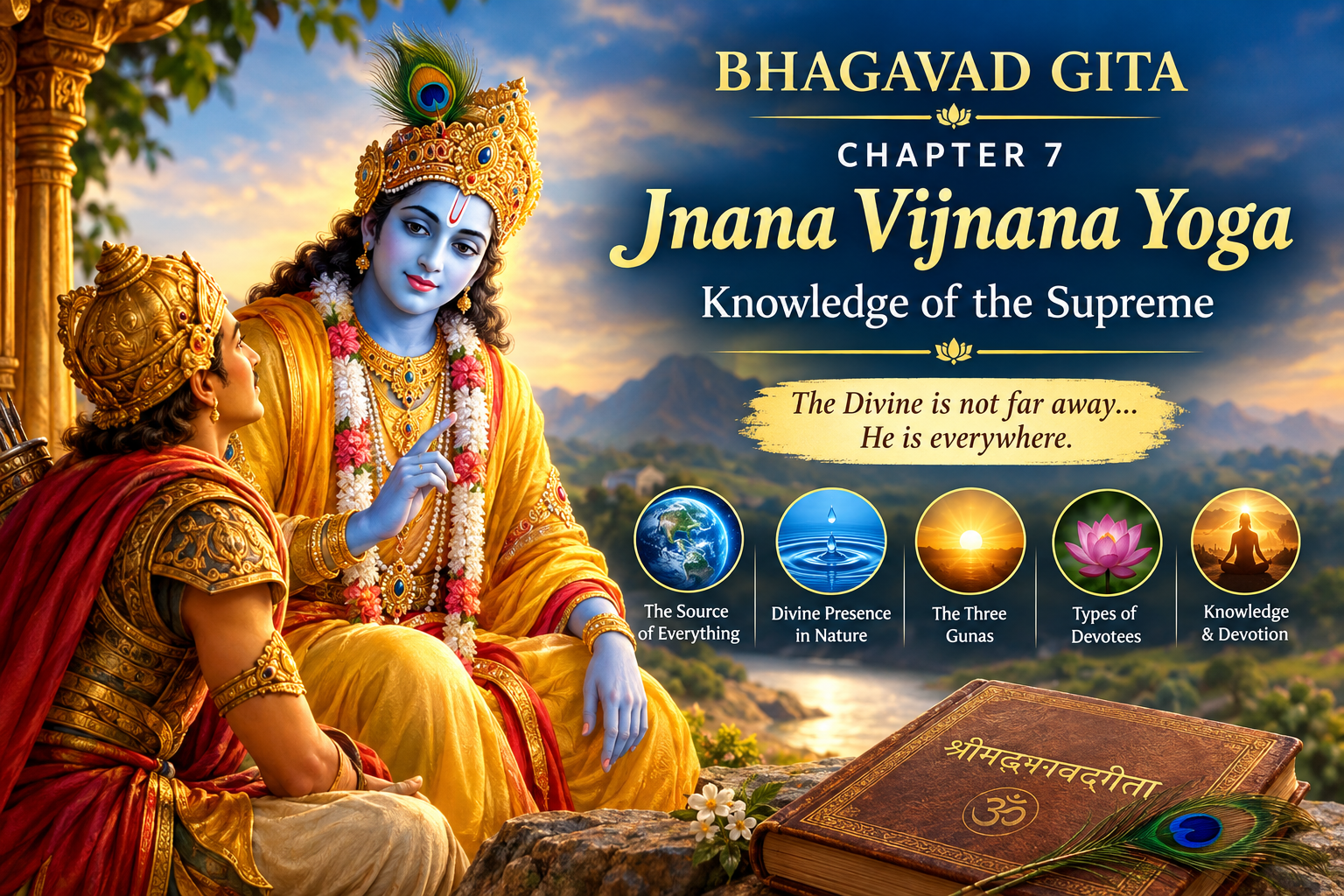
📖भगवद्गीता अध्याय :७ (ज्ञानविज्ञानयोग — परमेश्वराचे ज्ञान व स्वरूप) Jnana Vijnana Yoga: Knowledge of the Supreme
Sep 30, 2026 · 6 min read · 127 views
Introduction
The Bhagavad Gita Chapter 7, known as Jnana Vijnana Yoga, explains the knowledge of the Supreme Lord and the true nature of the Divine. In this chapter, Lord Krishna teaches Arjuna how a person can understand God through both spiritual knowledge and direct realization.
The Sanskrit words “Jnana” and “Vijnana” have deep meanings. Jnana refers to knowledge and understanding, while Vijnana refers to realized or experiential knowledge. Lord Krishna explains that merely collecting information about the Divine is not enough. A person should gradually develop devotion, spiritual understanding, and inner realization.
This chapter beautifully connects knowledge, devotion, nature, and the Supreme Reality.
What Is Jnana Vijnana Yoga?
Jnana Vijnana Yoga means the Yoga of Knowledge and Realization. Lord Krishna begins by explaining that He will reveal knowledge through which Arjuna can know Him completely.
Krishna teaches that the Supreme Divine is the ultimate source behind everything that exists. The material universe and all living beings are connected to Him.
According to Krishna, understanding the Divine requires both:
- Jnana – spiritual knowledge
- Vijnana – direct realization of that knowledge
When knowledge becomes part of one's experience and way of life, it becomes spiritual realization.
Krishna as the Source of Everything
Lord Krishna explains that the entire universe exists through His divine energy. He describes His lower material nature as consisting of eight elements:
1. Earth
2. Water
3. Fire
4. Air
5. Ether or Space
6. Mind
7. Intellect
8. Ego
These elements form the material aspect of creation.
Beyond this material nature is the higher spiritual energy, which consists of living beings. Thus, both the material and living aspects of existence are connected with the Supreme.
Krishna presents Himself as the ultimate source and foundation of creation.
The Divine Presence in Nature
One of the beautiful teachings of Chapter 7 is that the Divine can be recognized through the world around us.
Krishna says that He is present as the taste in water, the light of the Sun and Moon, the sacred syllable Om, the sound in space, and the strength found in living beings.
This teaching encourages people to see spirituality not only in temples and religious practices but also in everyday life and nature.
A simple experience such as drinking water, seeing sunlight, or observing the beauty of nature can become an opportunity to remember the Divine.
Maya and the Three Gunas
Krishna also explains the power of Maya, the divine cosmic energy through which the material world operates.
Maya is associated with the three Gunas:
- Sattva – purity, harmony, knowledge and balance
- Rajas – activity, desire and attachment
- Tamas – ignorance, darkness and inertia
These three qualities influence human thoughts, actions, emotions, and behavior.
Krishna explains that Maya is difficult to overcome through personal effort alone. However, those who sincerely seek refuge in the Divine and develop devotion can move beyond its influence.
Four Types of Devotees
In Chapter 7, Krishna describes four kinds of people who turn toward Him:
1. The distressed – those who seek divine support during difficulties.
2. The seeker of knowledge – those who want to understand the truth.
3. The seeker of worldly goals – those who approach God with specific desires.
4. The wise devotee – one who knows the Divine and develops selfless devotion.
Krishna especially praises the wise devotee whose devotion is deeply rooted in spiritual understanding.
This does not mean that other forms of devotion are meaningless. Rather, the Gita shows how devotion can gradually develop from seeking help to seeking the Divine Himself.
Why People Do Not Recognize the Supreme
Although the Divine is present everywhere, people may fail to recognize it because of ignorance, attachment, desires, and the influence of Maya.
Human beings often become absorbed in temporary things and forget the deeper reality behind existence.
Krishna teaches that spiritual understanding helps a person move beyond temporary attractions and recognize the eternal nature of the Supreme.
Different Forms of Worship
People may worship different deities according to their faith, desires, and understanding. Krishna explains that the Divine ultimately supports the faith of those who sincerely worship.
However, the results obtained through desire-based worship are generally temporary, whereas realization of the Supreme leads toward the eternal.
The chapter therefore encourages seekers to move gradually from temporary desires toward deeper spiritual understanding.
The Importance of Devotion
A central message of Jnana Vijnana Yoga is that knowledge and devotion complement each other.
Knowledge helps a person understand the nature of reality, while devotion helps develop a loving relationship with the Divine.
True spiritual growth is not simply about knowing religious concepts. It involves transforming one's thoughts, actions, and attitude toward life.
A person who remembers the Divine with sincerity can gradually develop peace, faith, and inner strength.
Lessons from Bhagavad Gita Chapter 7
Chapter 7 provides several important lessons for modern life:
1. Knowledge should lead to realization
Learning spiritual teachings is valuable, but applying them in daily life is equally important.
2. The Divine is present everywhere
Spirituality can be experienced through nature, life, and everyday moments.
3. Desires can distract the mind
Constant attachment to temporary achievements can prevent a person from recognizing deeper spiritual truths.
4. Devotion provides inner strength
Faith and devotion can help a person face difficulties with courage and patience.
5. Spiritual progress is gradual
A person's journey toward the Divine may begin with a desire for help, knowledge, or peace and gradually develop into deeper devotion.
Conclusion
Bhagavad Gita Chapter 7 – Jnana Vijnana Yoga presents a profound teaching about the knowledge and realization of the Supreme. Lord Krishna explains His relationship with nature, living beings, Maya, and the entire universe.
The chapter reminds us that the Divine is not separate from creation. By developing spiritual knowledge, sincere devotion, and a deeper awareness of life, a person can move toward realization of the Supreme Reality.
Jnana gives us understanding, while Vijnana transforms that understanding into realization. Together, they guide a spiritual seeker toward a deeper and more meaningful life.
Frequently Asked Questions
What is Chapter 7 of the Bhagavad Gita called?
Chapter 7 of the Bhagavad Gita is called Jnana Vijnana Yoga, meaning the Yoga of Knowledge and Realization.
What is the main message of Chapter 7?
The main message is to understand the Supreme Lord, recognize His presence in creation, overcome the influence of Maya, and develop sincere devotion.
What does Jnana mean?
Jnana means knowledge, particularly spiritual knowledge and understanding of the nature of reality.
What does Vijnana mean?
Vijnana refers to realized or experiential knowledge—the direct understanding of spiritual truth.
What are the three Gunas?
The three Gunas are Sattva, Rajas, and Tamas. They represent different qualities of material nature and influence human thoughts and behavior.
How can a person progress spiritually according to Chapter 7?
A person can progress through spiritual knowledge, sincere devotion, self-discipline, remembrance of the Divine, and gradually reducing attachment to temporary desires.
#BhagavadGita #Chapter7 #JnanaVijnanaYoga #LordKrishna #KrishnaTeachings #GitaWisdom #SanatanDharma #Hinduism #Spirituality #BhagavadGitaTeachings #Krishna #SpiritualKnowledge #VedicWisdom
More in Bhagavad Gita

What is Bhagavad Gita? – The Complete Guide to Bhagavad Gita

📖 भगवद्गीताअध्याय: १ — अर्जुनविषादयोग (Arjuna Vishada Yoga)
