
📖भगवद्गीताअध्याय :३Karma Yoga – The Path of Selfless Action ( निष्काम कर्माचा मार्ग)
Sep 25, 2026 · 4 min read · 108 views
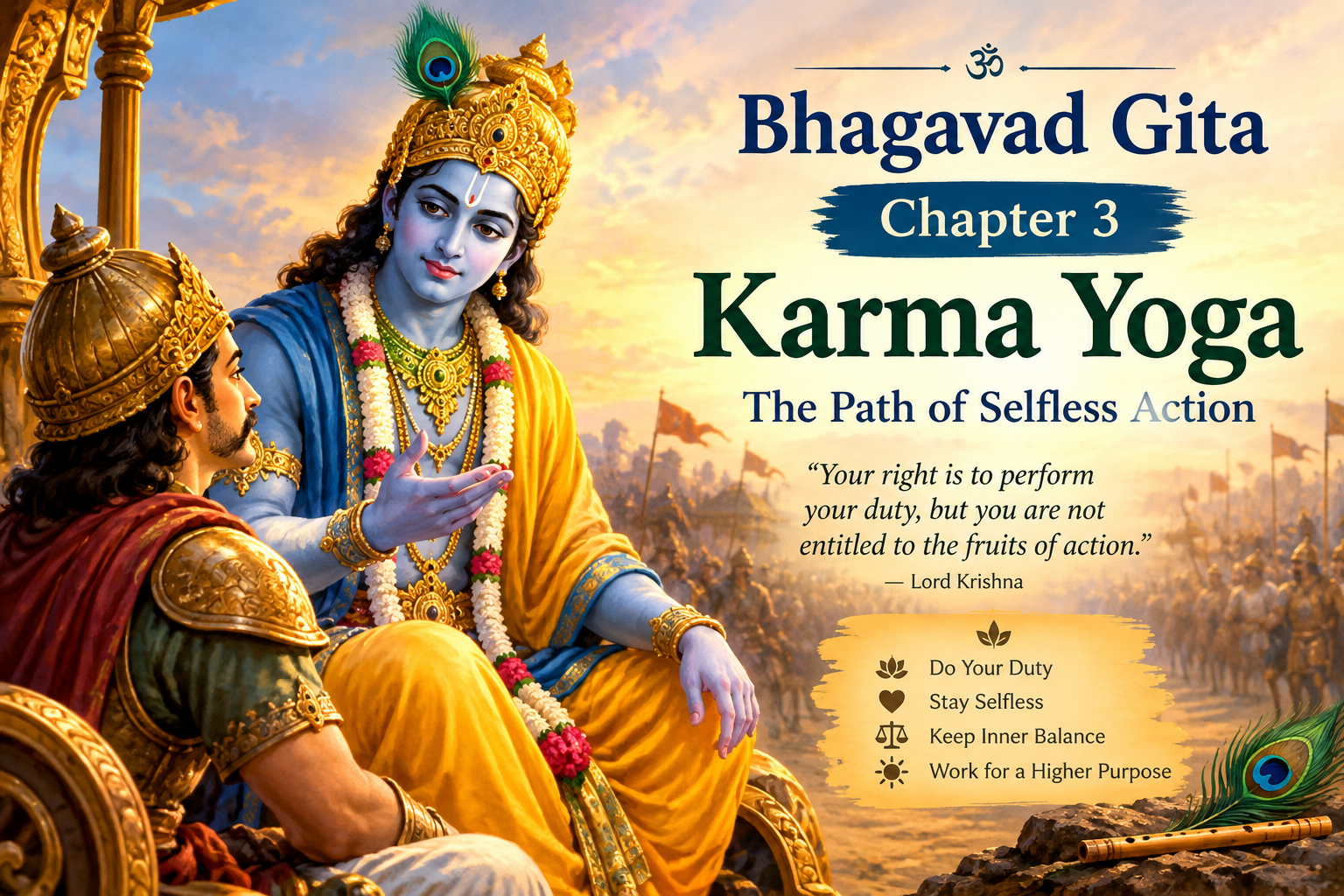
Introduction
The Bhagavad Gita is one of the most important spiritual texts of Hindu philosophy. It contains the teachings of Lord Krishna to Arjuna on the battlefield of Kurukshetra. The third chapter of the Bhagavad Gita is known as Karma Yoga, which means the path of selfless action.
In this chapter, Lord Krishna explains why action is necessary in life and how a person can perform duties without being attached to the results. Karma Yoga teaches us to perform our responsibilities sincerely, with dedication, and without excessive attachment to success or failure.
What Is Karma Yoga?
Karma Yoga is the practice of performing one's duties with a selfless attitude. It does not mean giving up worldly responsibilities. Instead, it teaches us to fulfil our responsibilities honestly while maintaining inner balance.
Every person has duties toward family, society and life. Avoiding action is not the solution. Lord Krishna explains that no one can remain completely inactive because everyone is naturally involved in some form of action.
The important point is not simply what we do, but the attitude with which we perform our actions.
The Meaning of Selfless Action
Selfless action, or Nishkama Karma, means performing an action without being excessively attached to its reward.
A person should make sincere efforts and focus on doing the right thing. The final result may not always be under our complete control.
For example, a student can study sincerely, but the exact examination result depends on many factors. Similarly, a person can work honestly and diligently without allowing the desire for recognition or reward to disturb inner peace.
Importance of Duty
One of the central teachings of Chapter 3 is the importance of performing one's duty.
Everyone has different responsibilities according to their circumstances. A parent has responsibilities toward children, a teacher toward students, and a professional toward their work.
When duties are performed with sincerity and responsibility, they become a form of spiritual practice.
Karma Yoga in Daily Life
The teachings of Karma Yoga are not limited to ancient times. They can be applied to everyday life.
Whether we are working at a job, running a business, studying, managing a home, or helping others, we can practise Karma Yoga by doing our work sincerely.
Instead of constantly worrying about “What will I get?”, we can ask ourselves, “Am I doing my duty properly?”
This change in attitude can help us develop patience, discipline and inner stability.
The Role of Desire and Attachment
Desire itself is a natural part of human life. However, excessive attachment to a particular result can create anxiety and disappointment.
Karma Yoga encourages us to make sincere efforts while learning to accept the outcome with balance.
Success should not make us arrogant, and failure should not completely break our confidence. Both experiences can become opportunities to learn and grow.
Work for the Welfare of Others
Chapter 3 also highlights the importance of action for the welfare of society.
Our actions can influence other people. When responsible and respected individuals perform their duties sincerely, they can inspire others to do the same.
Therefore, Karma Yoga is not only about personal spiritual growth. It also encourages responsible participation in family and society.
What Bhagavad Gita Chapter 3 Teaches Us
The main lessons of Karma Yoga include:
- Perform your duties sincerely.
- Do not run away from responsibilities.
- Avoid excessive attachment to the fruits of action.
- Keep your mind balanced in success and failure.
- Perform actions with a selfless attitude.
- Work for the welfare of others.
- Let discipline and wisdom guide your actions.
Bhagavad Gita Chapter 3, Karma Yoga, gives a practical message for everyday life. It teaches that action is an essential part of human existence and that our responsibilities should be performed with sincerity and dedication.
The true spirit of Karma Yoga lies in doing the right action without being consumed by the desire for a particular result. When our actions are guided by duty, selflessness and wisdom, everyday work can become a path toward inner growth and spiritual understanding.
The message of Karma Yoga remains meaningful even today: Perform your duty sincerely, give your best effort, and maintain peace within yourself regardless of the outcome.
What is Chapter 3 of the Bhagavad Gita called?
Chapter 3 is called Karma Yoga.
What is the main message of Karma Yoga?
Its main message is to perform one's duties sincerely without excessive attachment to the results.
What does Nishkama Karma mean?
Nishkama Karma means performing actions without selfish attachment to their fruits.
Can Karma Yoga be practised in daily life?
Yes. It can be practised by performing everyday responsibilities with sincerity, discipline and a selfless attitude
More in Bhagavad Gita

What is Bhagavad Gita? – The Complete Guide to Bhagavad Gita

📖 भगवद्गीताअध्याय: १ — अर्जुनविषादयोग (Arjuna Vishada Yoga)
