
📖भगवद्गीताअध्याय ४ : ज्ञानकर्मसंन्यासयोग (Jnana Karma Sannyasa Yoga)
Sep 26, 2026 · 8 min read · 102 views
Introduction
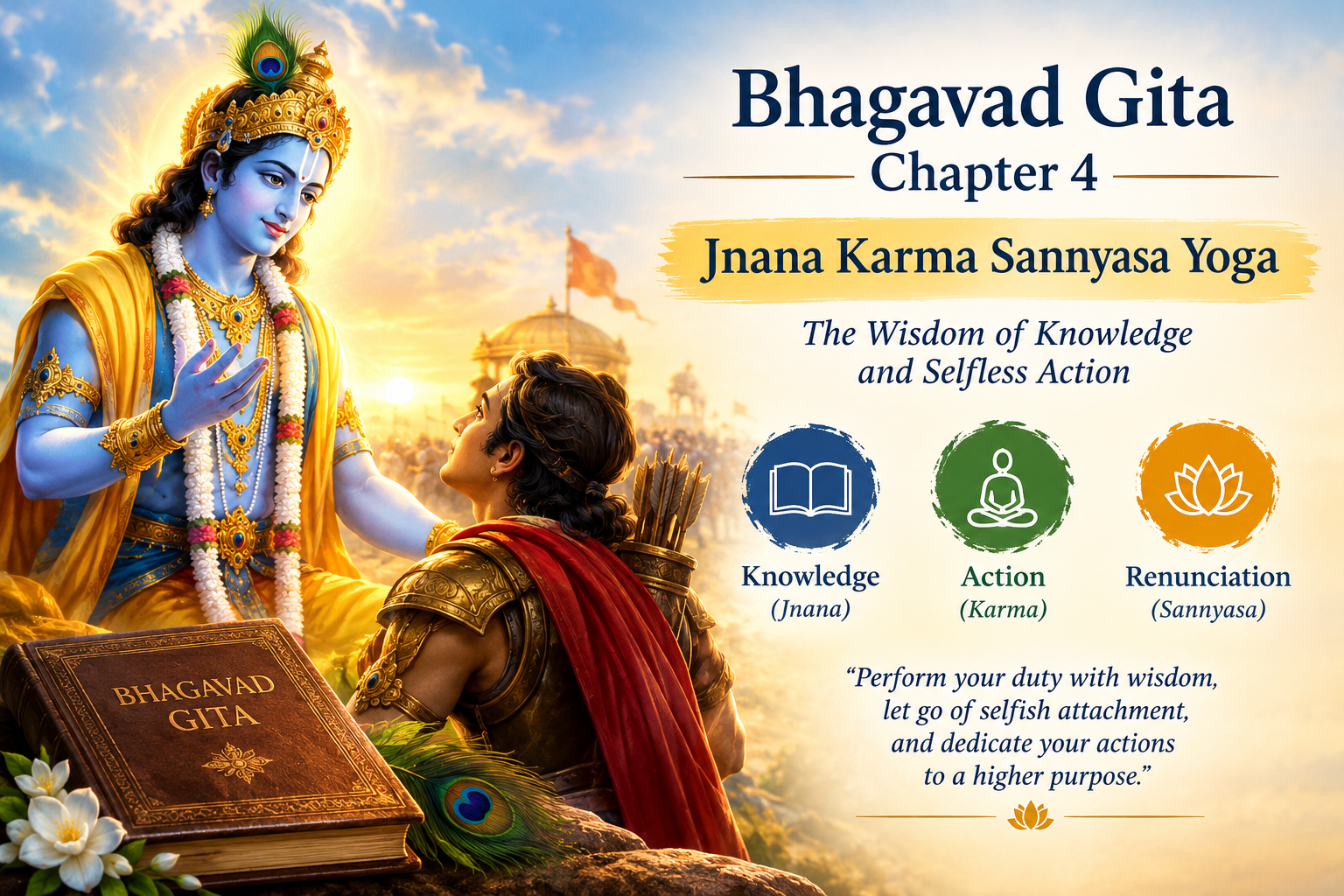
The Bhagavad Gita, one of the most profound spiritual texts of ancient India, offers timeless guidance on life, duty, knowledge, devotion, and self-realisation. In Chapter 4, known as Jnana Karma Sannyasa Yoga, Lord Krishna explains the relationship between spiritual knowledge, selfless action, and renunciation.
The Sanskrit term Jnana Karma Sannyasa Yoga can be understood as the Yoga of Knowledge and Renunciation of Action. This chapter teaches that true renunciation does not necessarily mean abandoning worldly responsibilities. Instead, it means performing one's duties without selfish attachment to the results.
Lord Krishna also explains the divine purpose behind His appearance in the world, the importance of spiritual knowledge, the nature of karma, and the role of a true spiritual teacher.
---
What Is Jnana Karma Sannyasa Yoga?
Jnana Karma Sannyasa Yoga combines three important ideas:
- Jnana – spiritual knowledge or wisdom
- Karma – action or duty
- Sannyasa – renunciation of selfish attachment
According to Krishna's teaching, action performed with wisdom and without selfish attachment can become a path to spiritual freedom.
A person does not become spiritually liberated simply by stopping all activities. What matters is the attitude behind one's actions. When actions are performed as a duty, without excessive attachment to personal rewards, they gradually purify the mind.
---
The Ancient Wisdom of Yoga
At the beginning of Chapter 4, Lord Krishna tells Arjuna that this spiritual teaching is ancient. He explains that the wisdom of Yoga was passed down through a tradition of enlightened teachers.
Over time, however, this knowledge became less accessible because its deeper meaning was forgotten. Krishna therefore reveals it again to Arjuna.
This teaches an important principle: spiritual wisdom may be ancient, but its relevance remains timeless. Every generation can rediscover its meaning and apply it to contemporary life.
---
Why Does Lord Krishna Appear in the World?
One of the most well-known teachings of the Bhagavad Gita appears in Chapter 4.
Krishna explains that whenever righteousness declines and harmful forces increase, He manifests Himself to restore balance.
His divine purpose is described as:
- Protecting those who uphold righteousness
- Challenging destructive and unjust forces
- Restoring Dharma
- Re-establishing spiritual values
This teaching is traditionally understood as an explanation of divine intervention whenever the balance between righteousness and unrighteousness is disturbed.
---
The Meaning of Dharma
The word Dharma has a deep meaning. It is not limited to religion. It can refer to righteousness, duty, moral responsibility, and the principles that sustain harmony.
In everyday life, following Dharma may involve acting honestly, fulfilling responsibilities, respecting others, showing compassion, and choosing what is right even when it is difficult.
The Bhagavad Gita teaches that Dharma should be understood not merely as an external rule but as a principle of responsible and ethical living.
---
Karma and the Mystery of Action
Chapter 4 explores the complex nature of Karma.
Every action has consequences, but Krishna teaches Arjuna to understand action beyond simple ideas of success and failure.
A person can become bound by actions when they are driven by:
- Greed
- Ego
- Desire for recognition
- Attachment to results
- Selfish motives
On the other hand, action performed with wisdom, responsibility, and dedication can become a means of spiritual growth.
Therefore, the important question is not simply “What am I doing?” but also “Why am I doing it?”
---
The Importance of Selfless Action
Selfless action is one of the central ideas of the Bhagavad Gita.
A person should perform their responsibilities sincerely while reducing excessive attachment to the outcome.
For example, a teacher may teach students sincerely without being obsessed with praise. A parent may care for a child without expecting constant recognition. A professional may perform their work honestly without allowing success or failure to completely determine their sense of self-worth.
This approach creates inner stability.
---
Knowledge Is the Highest Purifier
Lord Krishna places great importance on spiritual knowledge.
Knowledge helps a person understand:
- The difference between the temporary and the eternal
- The nature of the Self
- The consequences of actions
- The importance of detachment
- The deeper purpose of life
According to the Gita, genuine knowledge can remove ignorance just as light removes darkness.
However, this knowledge is not merely intellectual information. It is wisdom that transforms the way a person understands life and responds to circumstances.
---
Learning from a Spiritual Teacher
Chapter 4 also explains the importance of approaching a genuine spiritual teacher with humility, sincere questions, and a willingness to learn.
A true teacher does not merely provide information. Spiritual guidance can help a seeker understand deeper truths that may not be recognised through ordinary intellectual study alone.
The qualities of a sincere seeker include:
- Humility
- Respect
- Curiosity
- Discipline
- Sincere questioning
- Willingness to apply wisdom in life
Spiritual learning becomes meaningful when knowledge is put into practice.
---
Different Forms of Spiritual Practice
Krishna describes different forms of sacrifice and spiritual discipline. These practices are not limited to ritual activities.
They can include:
- Study and learning
- Self-discipline
- Meditation
- Control of the senses
- Charity
- Offering one's actions to a higher purpose
- Cultivating spiritual knowledge
The deeper message is that human activities can become spiritual practices when performed with awareness and the right intention.
---
Knowledge and Freedom
The Bhagavad Gita teaches that ignorance can create attachment, fear, confusion, and repeated suffering.
Spiritual knowledge helps a person understand reality more clearly.
When knowledge becomes established within a person, they can gradually become less controlled by:
- Anger
- Fear
- Excessive desire
- Ego
- Attachment
- Anxiety about results
This does not mean that life becomes free from challenges. Instead, the person develops a more balanced way of responding to those challenges.
---
The Role of Faith and Discipline
Knowledge does not develop through curiosity alone. Krishna emphasises the importance of faith, discipline, sincerity, and dedication.
A seeker who approaches spiritual knowledge with an open and disciplined mind can gradually experience deeper understanding.
Faith in this context does not mean blindly accepting everything. It can also mean having the sincerity and patience to explore spiritual principles and apply them thoughtfully.
---
The Difference Between Renunciation and Escaping Responsibility
A common misunderstanding of renunciation is that a person must abandon work, family, or society.
Chapter 4 presents a deeper perspective.
True renunciation is primarily about giving up selfish attachment, not necessarily abandoning every responsibility.
A person may live an ordinary family or professional life while practising spiritual renunciation internally.
The key is to perform one's responsibilities without allowing ego and attachment to control the mind.
---
How Chapter 4 Applies to Modern Life
The teachings of Jnana Karma Sannyasa Yoga remain relevant in today's world.
Modern life often brings pressure related to career, money, social recognition, relationships, and personal achievement. People may become deeply attached to outcomes and constantly compare themselves with others.
The teachings of Chapter 4 encourage a different approach:
Do your work sincerely. Learn continuously. Accept that results are not completely under your control. Reduce selfish attachment. Develop wisdom and maintain inner balance.
This approach can help a person face success and failure with greater stability.
---
Key Lessons from Chapter 4
The major teachings of Jnana Karma Sannyasa Yoga can be summarised as follows:
1. Spiritual wisdom is timeless.
2. Dharma helps maintain moral and spiritual balance.
3. Divine intervention is associated with the restoration of righteousness.
4. Actions can bind a person when performed with selfish attachment.
5. Selfless action can become a path to spiritual growth.
6. Spiritual knowledge removes ignorance.
7. A sincere seeker should learn with humility and discipline.
8. True renunciation is not simply abandoning responsibilities.
9. The intention behind an action is deeply important.
10. Knowledge, action, and devotion can support the journey toward liberation.
---
Conclusion
Bhagavad Gita Chapter 4 – Jnana Karma Sannyasa Yoga provides a profound teaching about the relationship between knowledge, action, and renunciation.
Lord Krishna teaches Arjuna that spiritual life does not require escaping from responsibilities. Instead, one can transform ordinary duties into a spiritual path by performing them with wisdom, sincerity, discipline, and without excessive attachment to results.
The chapter reminds us that knowledge is not valuable merely because we possess information. Its true value lies in how it transforms our thoughts, actions, and understanding of life.
The timeless message of Chapter 4 can be expressed simply:
Act with responsibility, seek true knowledge, give up selfish attachment, and dedicate your actions to a higher purpose.
When knowledge guides action and action is performed without selfish attachment, everyday life itself can become a journey toward inner freedom.
---
Frequently Asked Questions (FAQ)
1. What is Chapter 4 of the Bhagavad Gita called?
Chapter 4 of the Bhagavad Gita is called Jnana Karma Sannyasa Yoga, meaning the Yoga of Knowledge and Renunciation of Action.
2. What is the main teaching of Chapter 4?
The main teaching is that spiritual knowledge and selfless action can lead a person toward inner freedom and liberation.
3. What does Jnana mean?
Jnana means spiritual knowledge or wisdom. It refers to deeper understanding of the Self, reality, Dharma, and the nature of existence.
4. What does Karma mean in the Bhagavad Gita?
Karma means action or duty. The Gita particularly emphasises performing one's responsibilities without selfish attachment to the results.
5. What does Sannyasa mean in Chapter 4?
Sannyasa refers to renunciation. In this context, it can be understood as renouncing selfish attachment rather than simply abandoning worldly responsibilities.
6. Why does Krishna say that He appears in the world?
Krishna explains that He manifests when Dharma declines and unrighteousness becomes dominant, with the purpose of restoring righteousness and balance.
7. Why is spiritual knowledge important?
Spiritual knowledge helps remove ignorance and allows a person to understand life, action, attachment, and the Self more deeply.
8. How can we apply Chapter 4 to modern life?
We can apply its teachings by performing our responsibilities sincerely, learning continuously, reducing attachment to outcomes, and developing greater awareness and self-discipline.
Final Thought
“Let knowledge guide your actions, let wisdom reduce your attachment, and let every sincere duty become a step toward inner peace.” 🙏
More in Bhagavad Gita
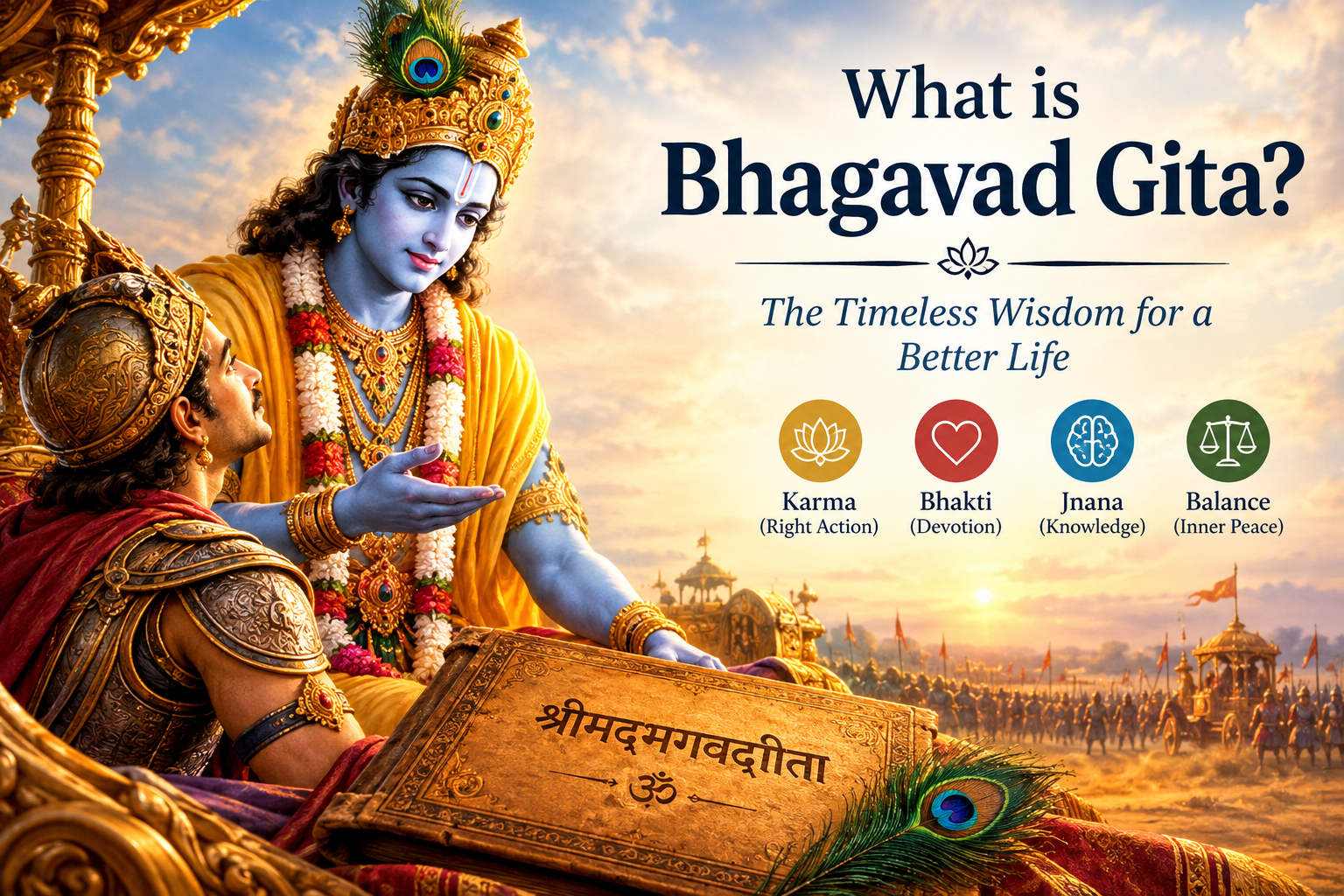
What is Bhagavad Gita? – The Complete Guide to Bhagavad Gita

📖 भगवद्गीताअध्याय: १ — अर्जुनविषादयोग (Arjuna Vishada Yoga)

📖भगवद्गीताअध्याय :२ सांख्ययोग — आत्मज्ञान व कर्माचे तत्त्वज्ञान Sankhya Yoga: The Knowledge of the Self and the Philosophy of Karma
1 Comments
Varalakshmiy Ramesh · 3 days ago
Chapter 5 missing in Bhagavad Gita explanations. Please include